


Everyone is learning AI right now.
Prompting. Agents. ChatGPT. Claude. Whatever shipped this week.
Good. Learn it.
I just wouldn’t bet my career on knowing the tools better than everyone else.
That advantage is depreciating way too fast.
A prompting trick becomes a button.
A workflow becomes a feature.
The thing that made you the AI person in the office six months ago becomes something everyone gets for free.
We’ve seen this movie before.
There was a time when knowing Excel was an edge.
Then Excel became work.
Nobody gets promoted because they know SUMIFS.
They get promoted because they know what numbers matter.
AI is heading there much faster.
Tool knowledge has the half-life of the tool.
And that creates a much more interesting problem.
AI is making intelligence cheap.
Research gets cheaper.
Analysis gets cheaper.
Code gets cheaper.
Content gets cheaper.
Ideas get very cheap.
But capital isn’t getting cheaper.
Neither is management attention.
Neither is engineering capacity.
Neither is organizational patience.
And nobody suddenly got an unlimited budget because Claude can write a better memo.
So we’re creating an interesting asymmetry:
AI is exploding the number of things a company could do without exploding the number of things a company can actually afford to do.
That matters.
A model can generate 100 plausible AI projects before lunch.
Your company cannot fund 100 projects before lunch.

The bottleneck moves.
It used to be:
Can we build this?
Increasingly it becomes:
Should we?
That is a very different skill.
We worked with a sales operations team that had a commission process spread across more than 60 sheets.
Every time it ran, roughly eight hours disappeared into copying, consolidating and checking data.
AI helped build the automation.
Eight hours became seconds.

Not sexy.
No autonomous workforce.
No breathless “agentic transformation.”
One ugly workflow stopped eating a workday.
I love that example precisely because it’s boring.
The data existed.
The process repeated.
The output was clear.
The result could be checked.
The economics earned the technology.
That is increasingly how I think companies should evaluate AI.
Not:
What agent should we build?
What AI platform should we buy?
What can we automate?
Start lower.
What problem deserves capital?
How often does it happen?
What does it cost today?
How much of the work can AI realistically absorb?
Does the data exist?
What systems does it touch?
What happens when it gets something wrong?
Where does a human need to stay in control?
What will this cost to implement?
And then the question people somehow manage to avoid:
Is there enough value here to bother?
Because technical feasibility and economic viability are not the same thing.
Something can be technically brilliant and economically stupid.
That distinction is going to matter a lot.
AI demos are extremely good at making bad economics look sexy.
Companies are surrounded by them.
“Customer service AI.”
“Sales agents.”
“Finance copilot.”
“AI transformation.”
These are categories.
They’re not investment units.
Capital gets deployed to workflows.
A workflow has a volume.
A baseline cost.
An owner.
Data.
Exceptions.
Risk.
Integration requirements.
An acceptable level of autonomy.
That’s where the math starts working.
And it also gets us away from this weird assumption that the end state of AI is removing humans from everything.
It isn’t.
AI can classify.
Extract.
Retrieve.
Draft.
Recommend.
Software can enforce deterministic rules.
Humans can keep authority where the consequences warrant it.
The useful question is not:
Can we remove the human?
It’s:
How much expensive work can the system absorb without creating more risk than value?
Sometimes the answer is 90%.
Sometimes it’s 30%.
Sometimes the first investment should be infrastructure.
Sometimes the answer is zero.
Kill it.
I think we need to get much more comfortable with that last answer.
Because killing an AI project is not anti-innovation.
Capital you don’t waste is capital you can put somewhere better.
That counts as return.
Same with pilots.
I keep seeing companies create AI pilots because nobody wants to say yes and nobody wants to say no.
Three months later, everyone learned something.
Six months later, they’re still piloting.
A pilot should exist to answer an uncertainty.
That’s it.
Three questions:
What don’t we know?
What number will tell us?
When do we make the decision?
If you can’t answer those before the pilot starts, you probably don’t have a pilot.
You have a hobby.
This is why I think the next phase of AI is going to look less like a technology problem and more like an allocation problem.
The opportunity set keeps expanding.
The constraint set doesn’t.
More models.
More capabilities.
More things we could automate.
Same finite capital.
Same finite attention.
Same finite organization.
And when a previously scarce input becomes abundant, value moves to the next constraint.
Intelligence was expensive.
Now it’s getting cheap.
Judgment isn’t.
Not philosophical judgment.
Operational judgment.
Knowing what deserves $500,000.
What deserves $50,000 and thirty days.
What needs infrastructure first.
What should remain human.
What should be tested.
What should be funded now.
And what impressive demo deserves exactly $0.
I call the system behind those choices decision architecture.
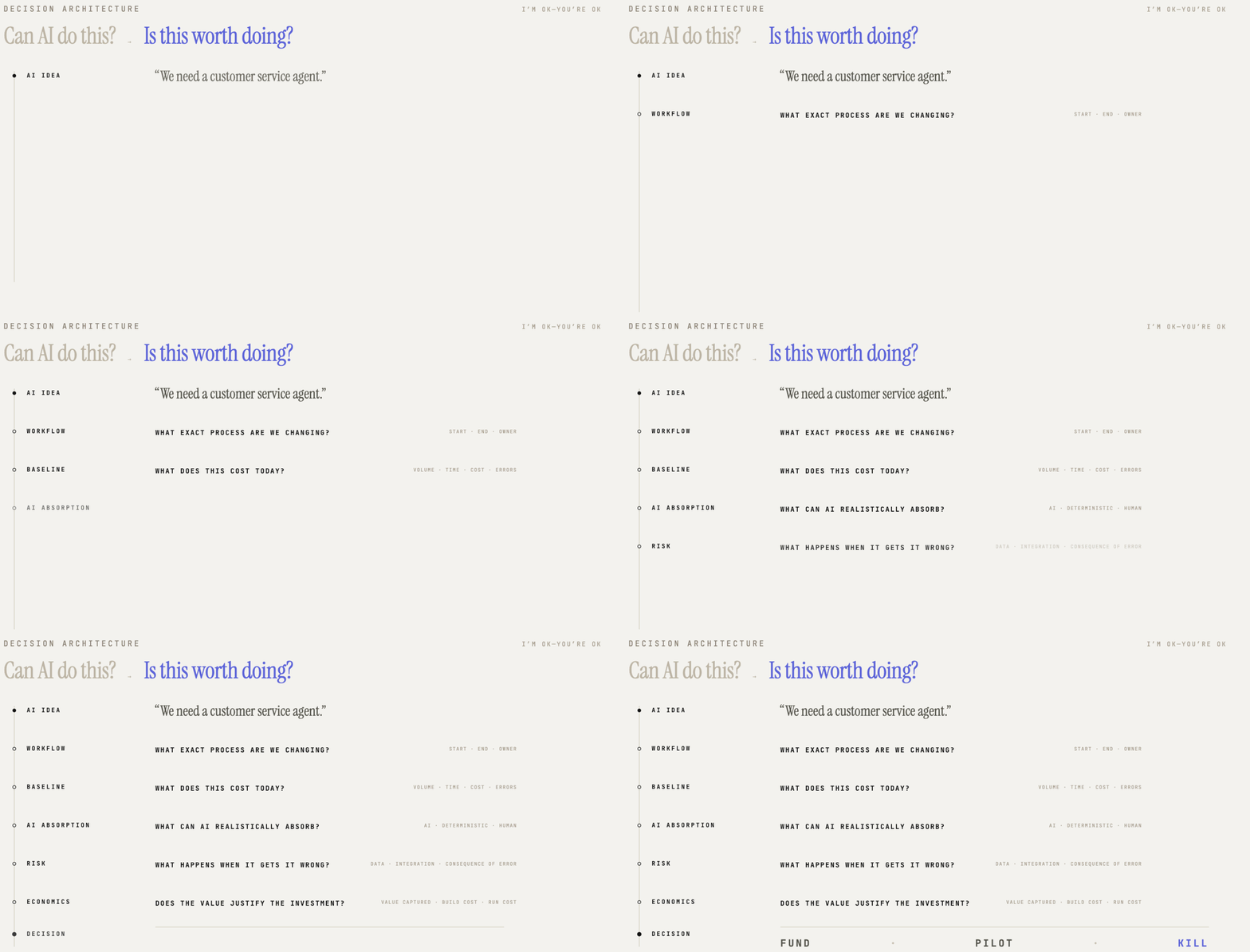
The person who can generate twenty AI ideas is becoming less scarce by the day.
The person who can correctly decide which two deserve investment is becoming more valuable.
That’s the bet.
AI literacy becomes baseline.
Technical capability keeps getting cheaper.
Companies get flooded with plausible things they could build.
And the winners won’t necessarily be the companies with the most AI.
They’ll be the companies that allocate better.
I think the same thing happens to careers.
Less value in memorizing the tool.
More value in knowing where to point it.
Less value in generating another competent answer.
More value in knowing which question matters.
Less value in coming up with twenty possibilities.
More value in being willing to kill nineteen of them.
The machines are getting smarter.
You’re still OK.
But what makes you valuable is changing.
That’s what I’m OK, You’re OK is about now.
Business. AI. Capital. Judgment.
What deserves building.
What doesn’t.
And what happens to human value when intelligence gets cheap.
Next:
Who becomes the most valuable person in the room?
I don’t think it’s the person who knows the most AI.
Subscribe if you want the next one. It’s free.
The m-dashes in this piece were added by a human, not AI.