

The easiest decision in corporate AI right now is approving a pilot.
It sounds responsible. Limited budget. Controlled risk. An opportunity to experiment before making a bigger commitment.
Nobody has to put their reputation on the line. We’re just testing.
Three months later, the demo works. The team is excited. Leadership wants to see more. Someone suggests expanding the pilot.
But ask a simple question: What did we learn that changes the investment decision?
Silence.
We’ve confused technical validation with business validation. And we’re spending a lot of money doing it.
A successful pilot can still be a terrible investment
Imagine your finance team spends eight hours every week consolidating information across dozens of spreadsheets.
You build an AI agent that completes the task in seconds.
Impressive? Absolutely.
Worth funding? We don’t know yet.
How much does the existing process actually cost? How often does it happen? How much of the recovered time translates into economic value? What will it cost to integrate the agent with existing systems, maintain it and manage exceptions?
And perhaps most importantly, what else could the company do with that same budget?
These are capital-allocation questions, not technology questions.
An AI project can work perfectly and still destroy value if implementing and maintaining it costs more than the problem it solves.
The opposite is also true. Something technically unremarkable can become one of the most valuable investments a company makes.
What happens when you start with the decision
We recently worked with a CPG and pharmaceutical manufacturer with approximately 5,000 employees.
We didn’t start by asking everyone to build an agent.
We started with executive leadership. Then we evaluated opportunities across nine business functions and developed a prioritized investment roadmap.
Twenty departments went on to build agents around real workflows, from regulatory and formulation to finance and HR.
One commission-consolidation process spanning more than 60 spreadsheets went from eight hours to seconds. A regulatory-review process went from eight days to two.
Within approximately a month, around 100 employees had progressed to building and maintaining their own agents.
Now the organization is looking at more ambitious opportunities, including enterprise-wide systems that require significant investments in data infrastructure and integration.
The decisions are becoming larger. So are the financial consequences.
And that’s exactly why the ability to evaluate these investments matters.
A pilot should have an expiration date
Before approving an AI project, I want to know three things.
What evidence would justify funding it?
Not whether a demo is technically possible. What measurable economic outcome would make this a worthwhile investment?
What is the biggest uncertainty?
Maybe the economics are attractive, but the data isn’t ready. Maybe the technology works, but nobody has established who will own the workflow.
A good pilot is designed to resolve a specific uncertainty, not demonstrate everything AI can do.
What would make us walk away?
This is the question companies rarely ask before they start spending.
Set the conditions for success and failure before building. Otherwise, every pilot becomes a reason to fund another pilot.
And every additional investment becomes harder to challenge because you’ve already spent the money.
Let’s put some real AI projects to the test
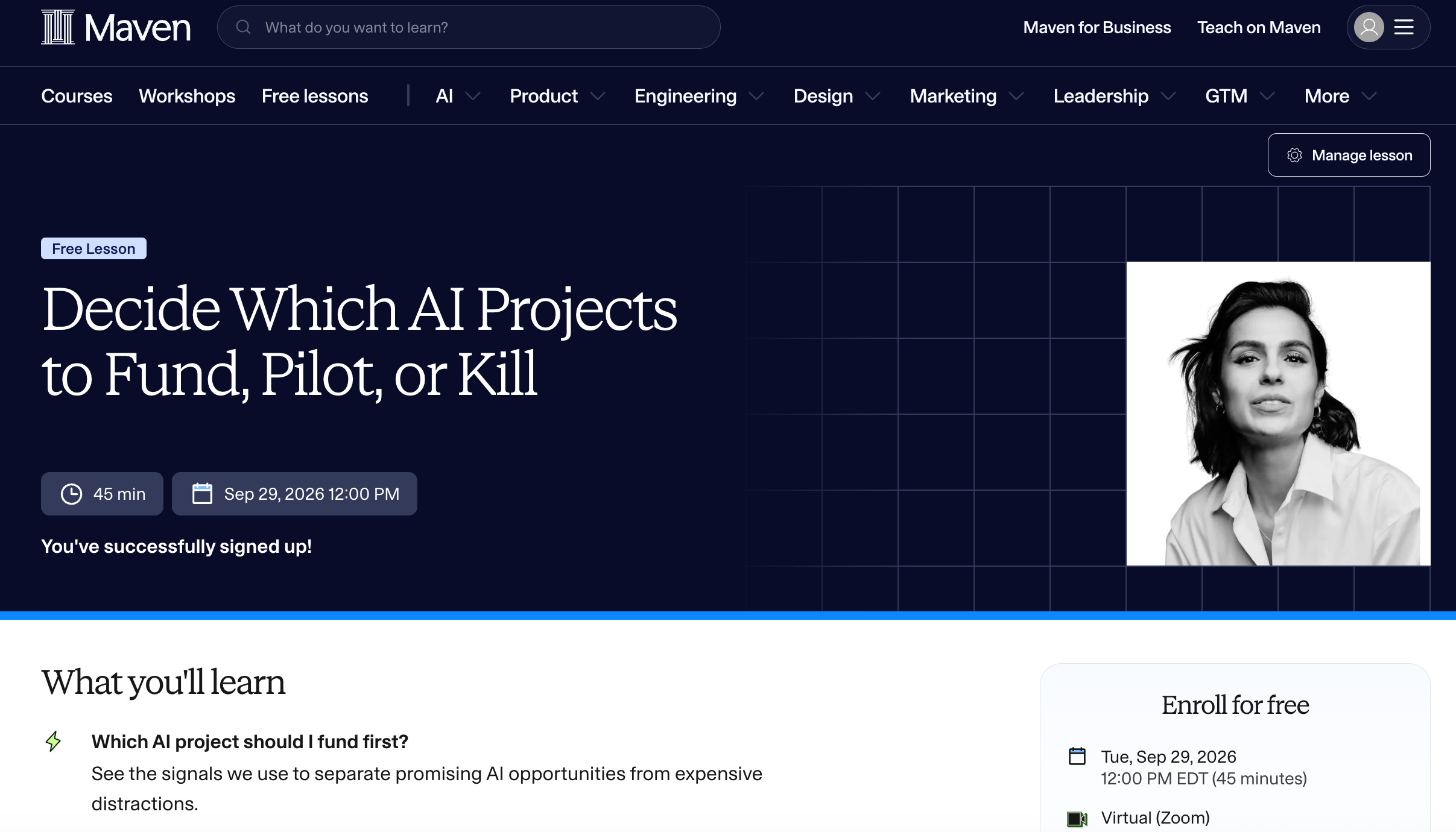
On September 29, I’m hosting a free, 45-minute live session: Decide Which AI Projects to Fund, Pilot, or Kill.
We’ll pressure-test real AI opportunities and examine the economics, feasibility, implementation costs and assumptions behind each investment.
You’ll see how to distinguish a project that deserves funding from one that needs a smaller experiment—or shouldn’t proceed at all.
And how to identify the variable that could change the decision.
If you’re responsible for AI investments, proposing an AI initiative or trying to defend a project in front of Finance, this is for you.
Tuesday, September 29 · 12 PM ET · Free
Bring a real AI project. Let’s find out whether it deserves the budget.